Quick Facts
- Route: Mangalore to Mumbai (flight in, road trip out)
- Vacationers: Raghav Bihani, Devpriya Bihani, Toral Ghelani
- Total distance: ~1,715 km driven (~1,830 km originally planned; Kolhapur leg skipped)
- Duration: 9 days
- Budget: ~₹82,000 for accommodation alone across the original 10-day plan, featuring stays from KSTDC lodges to high-end retreats like SwaSwara and Cintacor. All-in, including flights (~₹20,000), the car and driver (~₹40,000), and food, sightseeing, and guides on top, the trip came to closer to ₹2,00,000
The Itinerary at a Glance
| Day | Date | Route | Distance | Drive Time | Overnight |
|---|---|---|---|---|---|
| 1 | 18 Dec | Mumbai → Mangalore | – (flight) | ~1.5 hr flight | Urban Retreat, Mangalore |
| 2 | 19 Dec | Mangalore → Jog Falls (via Karkala, Udupi, Maravanthe, Murudeshwar, Honnavar) | ~270 km | ~6 hrs | KSTDC Mayura, Jog Falls |
| 3 | 20 Dec | Jog Falls → Karwar | ~150 km | ~3.5 hrs | Cintacor Island Resort |
| 4 | 21 Dec | Karwar → Gokarna | ~65 km | ~1.5 hrs | SwaSwara, CGH Earth |
| 5 | 22 Dec | Gokarna → Hampi | ~300 km | ~6.5 hrs | Hampi Boulders Resort |
| 6 | 23 Dec | Hampi (sightseeing, no travel) | – | – | Hampi Boulders Resort |
| 7 | 24 Dec | Hampi → Badami (via Anjaneya Hill) | ~120 km | ~3 hrs | KSTDC Mayura, Badami |
| 8 | 25 Dec | Badami → Aihole → Pattadakal → Banashankari → Bijapur → Solapur | ~240 km | ~4.5 hrs | Relative’s home, Solapur |
| 9 | 26 Dec | Solapur → Tuljapur → Pandharpur → Mumbai | ~570 km | ~9 hrs | Home |
Total driving: ~1,715 km over 7 driving days.
Introduction
December 2021 was the first time we properly got back on the road. Two waves of COVID had kept most of India indoors for the better part of two years, and even when travel had crept back, it was mostly villa and second-home stays, the kind that had exploded in popularity once working from home became normal. This trip was different: a proper driving holiday, and the first of its kind for us since the lockdowns.
Driving through India shows you a side of the country flying simply can’t. When you fly point to point, you get the destination and nothing else. Drive instead, and you get everything in between: the small towns, the roadside temples, the food that changes every hundred kilometres, the sense that a region’s culture and cuisine and history are all stitched together along the route rather than existing in isolated pockets. It’s a far more enriching way to see the country, and this trip left us wanting to do a lot more of India this way.
The plan was originally just Devpriya and me, with our friend Toral joining a little later once she decided to come along. To avoid the fatigue of driving the full stretch both ways, we flew from Mumbai to Mangalore and had a driver take our own car down separately to meet us there. He then took the train back home while we drove the car back ourselves. It meant we got to do the whole return leg in a car we were genuinely comfortable in, without the hassle (or compromise) of a one-way rental.


Day 1: Mumbai to Mangalore
The day itself was just a flight, Mumbai to Mangalore, uneventfully, which we were quietly grateful for given Mangalore’s notoriously short runway has seen its share of incidents over the years. Our driver, who’d brought our car down from Bombay separately, was waiting for us at the airport. We headed straight to dinner at Sagar Ratna, Ocean Pearl, a well-known local multi-cuisine spot better known for its South Indian fare. From there it was an early night at Urban Retreat, a small, no-frills bed and breakfast, neat, clean, and exactly what we needed before the drive properly began.
Our driver took the night train back to Bombay, and from the next morning it was just the three of us (Devpriya, Toral and me), all comfortable behind the wheel and ready to share the driving as we went.
Day 2: Mangalore to Jog Falls
A long one (around 280 km, five and a half to six hours of driving), so we started early. Our first stop, about an hour out of Mangalore, was the Gomateshwara statue at Karkala: a 42-foot monolith of Bahubali carved from a single block of granite in 1432, the second-tallest such statue in Karnataka after Shravanabelagola. The site was calm and nearly empty; you only really grasp how massive it is once you’re standing right beside it.

Ten kilometres away, the Attur Basilica made a good pairing: a minor basilica housing a statue of St. Lawrence, set in neat, well-kept grounds. It struck us how, within a few kilometres of starting the trip, we’d already passed a Jain monolith and a Catholic basilica, on the way to a Hindu heritage mutt (three faiths sitting comfortably within a short stretch of road), a small but genuine reminder of the coexistence and tolerance that runs through India.

From there it was another 40–50 km, roughly an hour, to Udupi and the Shree Krishna Mutt, an important pilgrimage site for the Vaishnavite tradition, with its striking silver-plated entrance and the daily rituals around Lord Krishna’s idol worth pausing to watch. Less obviously, Udupi is also where the dosa as we know it was born. The original Mitra Samaj near the temple complex is where it first got made, and it’s worth a stop for the culinary history alone if you’re a regular at Udupi restaurants back home. We were short on time, so we missed out on Malpe Beach, a clean, laid-back stretch a few kilometres from the temple, and the boat ride out to St. Mary’s Island just offshore, known for its unusual hexagonal basalt rock columns, among the few such formations in India. If we did this again, we’d break the day earlier with a night at Maravanthe instead, which now has some lovely properties, including a Postcard hotel, and would let us give Udupi the time it deserves.
Instead we pushed on, driving along Maravanthe Beach to Murudeshwar, about 90 minutes further. The Maravanthe stretch alone is worth the whole detour: you drive with the sea on one side and a backwater lake on the other for several kilometres; it’s one of the most photogenic coastal drives in India, and we stopped more than once just to take it in.


Murudeshwar itself is built around a 123-foot Shiva statue on Kanduka Hill, surrounded by the sea on three sides, and linked to the same Atmalinga legend we’d later hear the full story of at Gokarna (the covering Ravana tore off the linga in his fury is said to have landed here), worth a quick stop if you’re passing through, though not a special trip on its own.

Another 45 minutes or so brought us to Honnavar near sunset, where a backwater boat ride is highly recommended: we had the water almost entirely to ourselves as the sky turned orange, a genuinely peaceful way to end the driving for the day before the final stretch to Jog Falls.

We were so absorbed in the boat ride that we forgot to refuel, and by the time we were halfway to Jog Falls, the fuel light had come on. The stretch between Honnavar and Jog Falls runs entirely through forest, with no petrol pump in sight. The nearest one on the map was a detour our tank almost certainly wouldn’t survive. Just before the turn-off to our resort, we spotted a small roadside market and gambled that, like bikers often do, one of the shops might be stocking petrol. They did, but our car ran on diesel, which the shops didn’t stock, except for one shopkeeper who kept a canister of diesel on hand for the area’s generators, since load-shedding was common there. Beggars can’t be choosers: we bought what he had, poured it in, and only then continued on to the resort with the fuel light finally off, a useful reminder to watch your tank on drives like this, and exactly the kind of misadventure that ends up as one of the best stories from the trip.
Day 3: Jog Falls to Karwar
We woke up to excellent views of Jog Falls right outside our window, one big advantage of staying at the KSTDC property here, the only hotel with a direct view of the falls. KSTDC’s properties across Karnataka have consistently impressed us: clean, well-located, well-run, and a stark contrast to MTDC’s hotels back home in Maharashtra, which rarely measure up. Being December, the falls weren’t at full monsoon force, but several streams were still plunging down the rock face, enough to imagine how spectacular the sight must be in the rains. A good South Indian breakfast at the hotel, and we were on the road.


A light day by comparison: just a straight three-hour drive to Karwar, and this time we made sure to tank up the moment we passed a petrol pump, no repeat of yesterday’s adventure.

The highlight was our stay: Cintacor Island Resort, a genuinely one-of-a-kind property that occupies an entire private island (the only way in is by the resort’s own boat from a jetty in Karwar town, just south of Goa, where we left our car). It has the feel of a Maldivian getaway transplanted to the Indian coast: no one on the island but resort guests, around fifteen to twenty repurposed container rooms designed with real style, sea views from almost every corner, a small sand beach at one end, and an infinity pool restaurant looking out over the water for sunset. We reached by lunchtime and had the rest of the day entirely to ourselves: no sightseeing agenda, a deliberate pause after the packed first two days. It’s the kind of stop you could skip if short on time, but I’d strongly recommend it for the experience alone.


Day 4: Karwar to Gokarna
A short one (about 65 km, just under an hour and a half from Karwar), a light breather after the previous days. The whole day was built around our stay at SwaSwara, a wellness resort run by the CGH Earth group, which normally asks guests to commit to a five- or seven-day wellness programme. With COVID having thinned out bookings, they were making an exception and taking guests for one- or two-night stays, which gave us a chance to experience the property without the full commitment. CGH Earth’s properties lean rustic and earthy, rooted in Indian architecture and tradition, with genuinely good local food, one of the better hotel groups operating in South India.
SwaSwara’s rooms are beautifully designed, and the property itself is green and calm, with a large pool to unwind in and pleasant walking paths throughout the grounds. The real draw, though, is its direct walking path down to Om Beach, one of the main reasons we picked it. Even in the middle of the December peak season, the beach wasn’t overcrowded, busy but manageable. It lives up to its reputation as a proper soft-sand beach, good for a swim and an even better one for the sunset.


At the far end of the beach is Namaste Café, easily one of the most-recommended places to eat on Om Beach: excellent food with the beach practically at your feet, and, if I remember right, a few rooms of its own for anyone looking for a more affordable stay than SwaSwara. Dinner, though, was back at the hotel: a local, health-inspired buffet that stayed true to regional flavours while reworking them into lighter, more health-conscious dishes, all served in clay pots and traditional vessels, which added a nice touch to the whole meal.
Day 5: Gokarna to Hampi
Back at the resort, breakfast followed the same local, health-conscious philosophy as dinner the night before, different dishes, but every bit as thoughtfully put together. From there it was a long, straight drive to Hampi: six to seven hours, with a lunch stop at a dhaba along the way. The roads through Karnataka were in good shape throughout, which made a drive of this length far less tiring than it can sometimes be in India, and the three of us split the driving between us as usual.
Earlier that morning, before breakfast, I took an auto-rickshaw alone to the Mahabaleshwara Temple in Gokarna town. The other two weren’t quite ready to stir that early. It’s worth hiring the same auto for the round trip; since men have to remove their shirts before entering, the driver will happily hold onto it for you while you’re inside. Even at that hour, a small queue had formed. The temple dates to the 14th century, built in black granite and added to by successive rulers over time, in a typically Dravidian style with large windows and intricate carving, and a genuinely serene atmosphere despite the crowd. At its heart is the Atmalinga, housed in the innermost chamber, which one is permitted to approach and touch. The dress code is strict and worth knowing before you go: men must remove their shirts and wear a dhoti or lungi, women a sari; Western clothing isn’t permitted inside at all.
The Legend of the Atmalinga
Ravana, a devout worshipper of Shiva, was once granted the Atmalinga as a boon (a portable form of Shiva’s own essence, said to make invincible whoever kept it) on one condition: it could never touch the ground on the journey back to Lanka. As he neared the western coast of India, the gods, wary of what this would mean, conspired to stop him. Evening fell, and as a devout Brahmin, Ravana was bound to his sandhya prayers, but had no way to hold the heavy Linga while he did. Ganesha appeared before him disguised as a young cowherd boy, tending a herd of cows, and offered to hold the Linga, on condition that he’d call out three times, and if Ravana hadn’t returned by the third call, he would set it down. Ganesha called out in quick succession, and by the time Ravana rushed back, the Linga had already touched the earth at Gokarna and become immovable. As Ganesha and his cows sank back into the ground, a furious Ravana lunged to stop them, managing to grab hold of nothing but one cow’s ear as the rest vanished, which is how the town got its name, Gokarna, “cow’s ear.”
We reached Hampi by evening and had our first dinner at Laughing Buddha: a relaxed, popular café by the river, and a good, easy introduction to Hampi’s laid-back food scene before the sightseeing properly began the next day.
Day 6: Hampi Sightseeing
Our two days in Hampi were dedicated to the ruins of the Vijayanagara Empire, spread along the banks of the Tungabhadra River, a UNESCO World Heritage Site, and once one of the wealthiest empires in the world, at its peak home to close to half a million residents in a city then called Vijayanagara, “the city of victory.” Walking across the sheer scale of the ruins, scattered over kilometres, gives you a real sense of just how vast and prosperous the empire must have been five to six hundred years ago.
A good guide is essential at a site like this: without one, a visit to Hampi risks becoming a series of photographs rather than an actual understanding of the history, mythology, and culture behind what you’re looking at. We used Lokesh (+91 94482 12579), whose knowledge of the ruins added a great deal to our visit and who I’d happily recommend to anyone heading to Hampi.
The Rise and Fall of Vijayanagara
The Vijayanagara Empire reached its zenith in the 15th century under Emperor Krishnadevaraya, who commissioned many of the sites that draw visitors today, including the Vijaya Vittala Temple and the Mahanavami Dibba. The empire’s end came when the five Deccan Sultanates (Muslim kingdoms of the region) set aside their own rivalries to combine forces against Vijayanagara, defeating it and leaving the city to the ruin we see today.
We began at the Vijaya Vittala Temple, commissioned by Krishnadevaraya himself and famous for its iconic stone chariot, along with the celebrated musical pillars, best seen early, before the crowds arrive, since this is the single most-visited site in Hampi.


From there we moved to the Royal Centre, home to the Mahanavami Dibba, the emperor’s ceremonial victory platform, and the Hazara Rama Temple, whose walls carry an extraordinary sequence of Ramayana carvings. Nearby stood the Lotus Mahal, the queen’s pavilion, with its elegant Indo-Islamic arches set inside the old Zanana enclosure, and beside it the elephant stables: a long, symmetrical row of domed chambers built for the royal elephants, still remarkably intact.


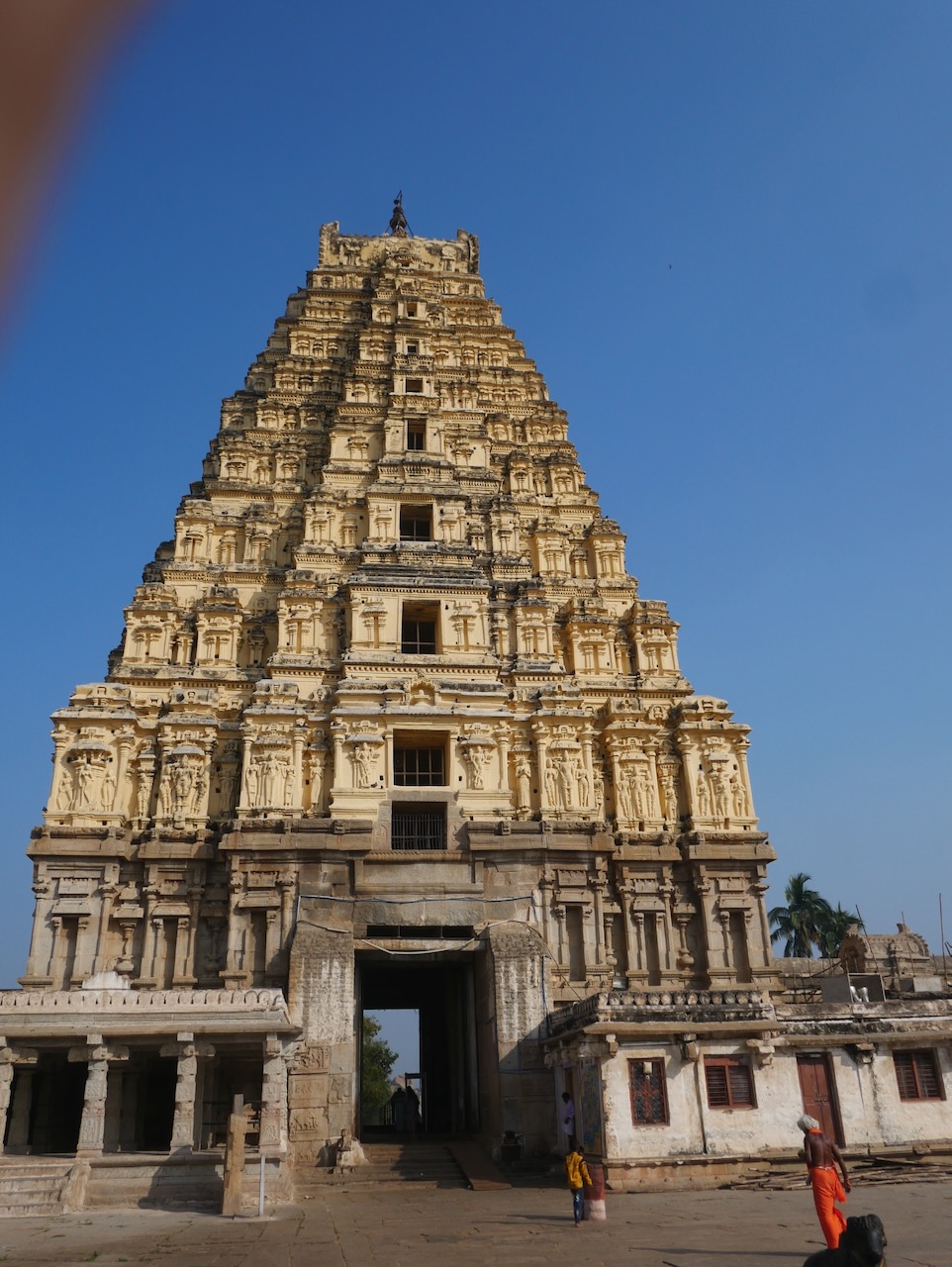
The second half of the day turned toward Hampi’s more spiritual sites. We saw the Badavilinga, a nine-foot monolithic Shiva lingam once submerged in water; the Ugra Narasimha, a fierce 22-foot monolithic statue of Vishnu in his half-man, half-lion form; and the Sasivekalu Ganesha, an eight-foot monolithic Ganesh carved into the slopes of Hemakuta Hill. The Virupaksha Temple is the only one of Hampi’s temples still functioning today, its 160-foot gopuram towering over the entrance. Inside, the ceiling of its main hall still carries faded but legible 16th-century murals of Hindu mythological scenes, among the very few surviving examples of Vijayanagara-era painting, worth looking up for, quite literally. The street leading up to the temple still shows traces of the grand market that once lined it on both sides during the empire’s peak.


By evening, we headed to the riverbank just behind Hampi Bazaar for the Tungabhadra coracle ride: a short, unmissable experience in the traditional circular wicker boats that drift past half-submerged boulders and ruins along the river, offering a genuinely serene way to close out the sightseeing. Right beside the bazaar stands the Yeduru Basavanna, a monolithic Nandi bull guarding the end of the street, worth a quick look on the way down to the water.

We ended the day with the steep climb up Matanga Hill, Hampi’s highest point, timed to catch the sunset, a 360-degree panoramic view over the boulder-strewn landscape that makes the climb entirely worth it. Dinner was at Mango Tree, one of Hampi’s most beloved cafés, known for its relaxed, cushioned floor seating, a fitting, laid-back way to end a day spent among the ruins, and one I’d recommend to anyone spending a night here.

Hampi’s Hippie Island and the Israeli Trail
For decades, Hampi has held an unlikely place on the global backpacker map as a stop on the “Hummus Trail”: the informal circuit through Asia favoured by young Israelis travelling after their mandatory IDF service, unwinding from years of rigorous training. While the southern bank of the Tungabhadra remained strictly sacred, vegetarian, and alcohol-free, the northern bank (Virupapur Gaddi, popularly known as Hippie Island) became the heart of this scene, drawing thousands of Israeli travellers every year. Local homestays and riverside shacks adapted accordingly, with menus across the island featuring pita, hummus, falafel, shakshuka, and lafa alongside local fare, and groups like Chabad establishing a presence to give travellers a place to connect. Following a Supreme Court demolition order in 2020, aimed at protecting the area’s ecological and archaeological sanctity, the Hampi World Heritage Authority tore down the commercial shacks lining Hippie Island, and much of that original backpacker energy has since faded from the northern bank. Even today, though, a good number of Hampi’s restaurants still carry a strong Israeli menu, a quiet trace of decades of this cross-cultural exchange.
Day 7: Hampi to Badami
Today’s drive took us from Hampi to Badami, another major archaeological site known for its rock-cut cave temples set beside a lake. Just north of Hampi, about half an hour along the way, lies Anjaneya Hill, traditionally regarded as the birthplace of Lord Hanuman, with a temple dedicated to him at the summit. There’s ample parking at the base, but reaching the top means climbing 575 steep steps, well laid out but not for the faint-hearted: several stretches require ducking under low boulders along the way. Temple aside, the climb rewards you with a genuinely spectacular 360-degree view: the Tungabhadra River winding below, lush green fields stretching out, and the ruins of Virupaksha and Vittala visible in the distance along the water. Even without the temple, the view alone justifies the climb.

The Legend of Anjaneya Hill
Anjana performed years of penance on this hill, praying for a child. Her prayers were answered by Vayu, the wind god, and she gave birth to Hanuman right here, making this one of the most significant sites associated with him anywhere in India.
Continuing on, we reached Badami around lunchtime. We were staying here too at a KSTDC property, which (as with Jog Falls) didn’t disappoint: neat, clean, functional, and a genuinely comfortable base. The Clarks and Badami Court were the other two options in town, but with December being peak season, both were already full; we were perfectly happy at the KSTDC regardless. After checking in and having lunch at the Clarks, we headed straight to the Badami cave temples.
As with Hampi, a good guide made a real difference across Badami, Aihole, and Pattadakal: without one, these sites are easy to skim past as just another set of old carvings, rather than a proper introduction to Chalukyan history and mythology. We used Basavraj (+91 94494 16423) for our time here, and I’d recommend him for Aihole and Pattadakal too.
That afternoon, we visited the Badami cave temples: a magnificent complex of four rock-cut shrines carved into the red sandstone cliffs of northern Karnataka, dating back to the early Chalukya dynasty of the 6th century CE, when the town was known as Vatapi and served as the dynasty’s capital. Overlooking the man-made Agastya Lake, the caves mark a crucial transition point in Indian temple architecture: the shift from simple rock-cut shrines toward the grand structural temples we later saw at Hampi.
Cave 1 is dedicated to Shiva, and greets you with a breathtaking 18-armed sculpture of Nataraja, Shiva’s cosmic dance; look closely and you can make out 81 distinct classical dance poses carved into the single figure. Cave 2 turns to Vishnu, its two most dramatic panels showing him as Trivikrama, conquering the three worlds with one giant leg raised high, and as Varaha, the wild boar avatar, rescuing the earth goddess from the ocean depths, both spectacular in scale and detail. Cave 3, the largest and most accomplished of the four, is dedicated to Vaishnavism and was commissioned by a Chalukya prince. Its centrepiece is a massive relief of Vishnu seated on the coiled multi-hooded serpent Adishesha, alongside striking carvings of Narasimha and Harihara, Vishnu and Shiva fused into a single form. The cave also holds faint traces of ancient frescoes, among the earliest surviving examples of mural painting in India. Cave 4, the smallest, is dedicated to Jainism, with a large sculpture of Mahavira seated on a lion throne inside the sanctum, and a striking high-relief image of Bahubali standing in deep meditation.


Right along the water’s edge of Agastya Lake sits the Bhutanatha Temple complex: a postcard-perfect monument framed by the same dramatic red sandstone cliffs, dedicated to Shiva in his fierce form as Bhutanatha, “lord of spirits and souls.” Local folklore holds that Shiva vanquished a demon named Bhuta at this very spot, its spirit bound ever since to the underground chambers below.

Our visit ended towards sunset, which is easily the best time to see the caves: the rock face, the lake, and the Bhutanatha temple all turn orange together as the sun drops, and the play of light across the carvings makes for a genuinely memorable close to the day. Dinner that evening was at Basaveshwar, serving genuine North Karnataka thalis, a satisfying, no-frills way to end a long day of sightseeing.
Day 8: Aihole, Pattadakal, and Banashankari
We set out early, before breakfast, for a quick loop to Aihole and Pattadakal, together forming the core of the Chalukyan temple circuit in northern Karnataka, and only about an hour and 15 kilometres from Badami respectively. If Aihole is the cradle of Indian temple architecture, Pattadakal is where those experiments were perfected (the “university” to Aihole’s laboratory), and the latter is a UNESCO World Heritage Site for its remarkably preserved ensemble of temples, still enclosed within a gated compound today.
Aihole, set on the banks of the Malaprabha River, served as an early Chalukyan capital and functioned as an open-air workshop where artisans experimented freely with temple styles, layouts, and forms. Over 120 temples and shrines survive here, spanning Hindu, Buddhist, and Jain traditions. The most striking is the Durga Temple: despite its name, it has no connection to the goddess Durga; “durga” here simply means fort, reflecting the temple’s unusual fortress-like design, from which it takes its name. Inside, heavily carved panels depict Vishnu’s avatars, Varaha and Narasimha, echoing carvings we’d already seen at both Hampi and Badami. The Lad Khan, Meguti, Ravana Phadi, and Galaganatha temples nearby are also worth a look; I stopped briefly at each of these on this visit.


From Aihole it was another 10–15 km back toward Badami to Pattadakal, which served as the Chalukyas’ ceremonial capital and coronation site. What makes Pattadakal unique is its side-by-side blend of both major Indian temple styles: Dravidian, from the south, with its pyramidal towers, and Nagara, from the north, with its curved shikharas, visible across the eight to ten temples within the main complex. The standout is the Virupaksha Temple, the largest and most ornate in the complex, directly inspired by the Kailasanatha Temple at Ellora, with vast pillared halls, detailed narrative panels from the Ramayana and Mahabharata, and a grand detached Nandi pavilion facing the sanctum.

Beyond Virupaksha, the complex holds several other temples worth pausing at. The Sangameshwara Temple, one of the oldest in the complex, is a Dravidian-style shrine dedicated to Shiva, built even before Virupaksha and sharing much of its architectural vocabulary. The Mallikarjuna Temple, standing right beside Virupaksha and built around the same time by a second Chalukya queen, is almost a smaller twin of it, sharing the same style and craftsmanship. The Galaganatha Temple, in the Nagara style, is one of the few here to lean fully North Indian, with a curved shikhara rather than the pyramidal Dravidian tower, a useful contrast to stand beside Virupaksha and see the two traditions side by side. The Jambulinga Temple, an early and smaller Dravidian shrine, rounds out the main cluster, while the Papanatha Temple, set slightly apart from the rest, is unusual for blending both Nagara and Dravidian elements within a single structure, an experiment that gives a good sense of the stylistic churn taking place here at the time.

Together, Aihole and Pattadakal are an extraordinary pairing: genuinely world-class sites in their own right, and easily deserving of a dedicated trip for anyone with a real interest in Indian temple architecture, whether Dravidian or Nagara.
On the drive back, we made a quick stop at Banashankari, a small temple village just outside Badami dedicated to the goddess Banashankari, an incarnation of Parvati and the tutelary deity of the Chalukya kings, a modest but worthwhile stop to round out the day’s temple-hopping.
After a late breakfast back in Badami, we set off for the long drive to Solapur (about 240 km, roughly four and a half hours) with a stop along the way at Bijapur (now officially Vijayapura), one of the five Deccan Sultanates that had combined to bring down the Vijayanagara Empire.
The city’s centrepiece is the Gol Gumbaz, the mausoleum of Sultan Mohammed Adil Shah, built through the mid-1600s and, at the time, the second-largest dome in the world after St. Peter’s Basilica in Rome. Its single vast chamber holds the tombs of the Sultan, his wives, daughter, grandson, and mistress. The real draw, though, is the whispering gallery that circles the interior of the dome: the acoustics here are extraordinary, with even the faintest whisper on one side clearly audible, echoing several times over, on the diagonally opposite side, nearly 40 metres away.

A short distance away is the Ibrahim Rauza, the tomb of Ibrahim Adil Shah II, built by the Sultan himself in the 1620s as the intended tomb for his wife, Taj Sultana, though as it turned out, he died before her, and became the tomb’s first occupant instead. Widely considered the finest example of Adil Shahi architecture, it pairs a tomb and a mosque facing each other across a shared plinth with a fountain and reservoir between them, both structures covered in extraordinarily detailed low-relief carving and calligraphy. Some scholars believe its refined symmetry may even have influenced the design of the Taj Mahal decades later.

We had lunch in Bijapur before continuing on to Solapur, where we spent the night at a relative’s house: a genuine heritage property, built in an old Indian architectural style, with massive halls and rooms opening onto verandahs, and a staircase leading down into a garden. It felt every bit like stepping into one of those grand old family mansions you don’t see built anymore. The family also runs a restaurant on part of the property, Swadisht, a multi-cuisine spot with excellent service, a place I’d recommend for dinner if you’re staying overnight in Solapur.
That evening, we visited Siddheshwar Temple, the city’s most important shrine and its guardian deity. Uniquely set on an island in the middle of Siddheshwar Lake, the temple was founded in the 12th century by the saint Siddharameshwar, a key figure in the Lingayat faith, who is said to have installed 68 Shiva lingams across the city, with this temple at their centre. Lit up in the evening and reflected across the lake, it made for a genuinely beautiful, peaceful close to a long day of driving and sightseeing.
Day 9: Solapur to Mumbai, via Tuljapur and Pandharpur
We’d arranged for our driver to take the overnight train from Mumbai back to us, and he arrived right on schedule at Solapur around 6 AM. I went alone with him to visit Tulja Bhavani Temple in Tuljapur, about an hour away on a smooth, newly built highway that made the drive quicker than expected. Tulja Bhavani is one of Maharashtra’s three-and-a-half Shakti Peethas (among the holiest seats of the goddess in the state) and holds particular significance in Maratha history: legend has it that the goddess herself gifted Chhatrapati Shivaji his sword before his battles, and the temple remains deeply woven into that legacy even today. I managed a quick darshan and was back at Solapur in time for a home-cooked breakfast at the house.
From there, the whole group set off, now chauffeured, for Pandharpur, home to the Vitthal-Rukmini Temple. The queue for darshan ran to about an hour and a half, but the atmosphere inside more than made up for the wait: genuinely spiritual, and Pandharpur as a temple town is well worth the visit in its own right.
The Legend of Pundalik and the Pandharpur Wari
According to legend, Lord Vishnu once came in person to visit a devotee named Pundalik, who was so absorbed in caring for his elderly parents that he couldn’t stop to receive him, instead tossing out a brick and asking the Lord to stand on it until he was free. Touched by Pundalik’s devotion, Vishnu chose to remain standing on that brick forever, taking the form of Vithoba, which is why the deity is depicted today, arms akimbo, standing on a brick beside his consort Rukmini. This legend also gave rise to the Pandharpur Wari, one of Maharashtra’s great living traditions: every year in the month of Ashadha, hundreds of thousands of Warkaris walk for weeks, from as far as Dehu and Alandi, carrying the padukas of Bhakti-era saints and singing devotional hymns the whole way, converging on Pandharpur on Ashadhi Ekadashi in a pilgrimage that has continued, largely unbroken, for over 800 years.
After Pandharpur, we stopped for lunch at a roadside dhaba: the best Maharashtrian food, in our experience, is almost always found at these highway joints rather than in restaurants, and we made a point of tasting the local fare as we went. The drive from Solapur, via Tuljapur and Pandharpur, back to Mumbai took around eight to nine hours, but with the trip winding down and our driver now back behind the wheel, it was a relaxed final stretch home, a fitting, unhurried end to a road trip that had taken us the length of the Karnataka coast, through the ruins of two great empires, and back into the heart of Maharashtra.
Optional Extension: The Kolhapur Detour
Our original itinerary included a two-day halt in Kolhapur, which we ultimately skipped but would still highly recommend for anyone with the extra time.
- Sightseeing: Budget a full day for the historic Panhala Fort, the lakeside Shalini Palace, and the Mahalaxmi Temple.
- Stay: Rankala Lake View was our originally booked property.
- Food: Perfect for trying Kolhapur’s iconic fiery breakfast bowl, Misal, at Phadtare, a vegetarian specialty the town is famous for.
Closing Thoughts
This was one of our first proper long-distance driving holidays: our own car, over 1,100 to 1,500 kilometres, stopping at every small site along the way rather than rushing between big destinations. It combined everything we love about travel: spiritual temples, extraordinary architecture, natural beauty, regional food and culture, and a run of genuinely memorable stays along the way. It remains one of our most memorable driving holidays to date, and it strengthened our belief that this is the best way to experience India: the real beauty of the country lies less in its big cities and more in these small towns and sites strung along the way between them.
It’s a drive I’d happily recommend to anyone looking to explore India this way, and one we consider genuine inspiration for future trips, not necessarily this exact route again, but more holidays built in this same spirit, showcasing India to our kids one day, once they’re old enough to take it all in.
#MangaloreToMumbai #RoadTripIndia #KarnatakaTourism #Hampi #Badami #Gokarna #IndianRoadTrip #WorldTravel #FamilyTravel #TravelBlog #IncredibleIndia
Leave a Reply