Quick Facts
- Where: Tadoba Andhari Tiger Reserve (TATR), Maharashtra (Khutwanda/Moharli gate area)
- When we went: 20–23 February 2020
- Ideal duration: 3 nights / 3 safaris minimum
- Getting there: Nagpur, 90–150 minutes by road depending on gate; overnight train or flight
- Best for: Groups chasing the best odds of an actual tiger sighting in India
- Budget level: Mid-range homestays to luxury lodges; safari permits alone can run ₹30,000+ for 3 drives
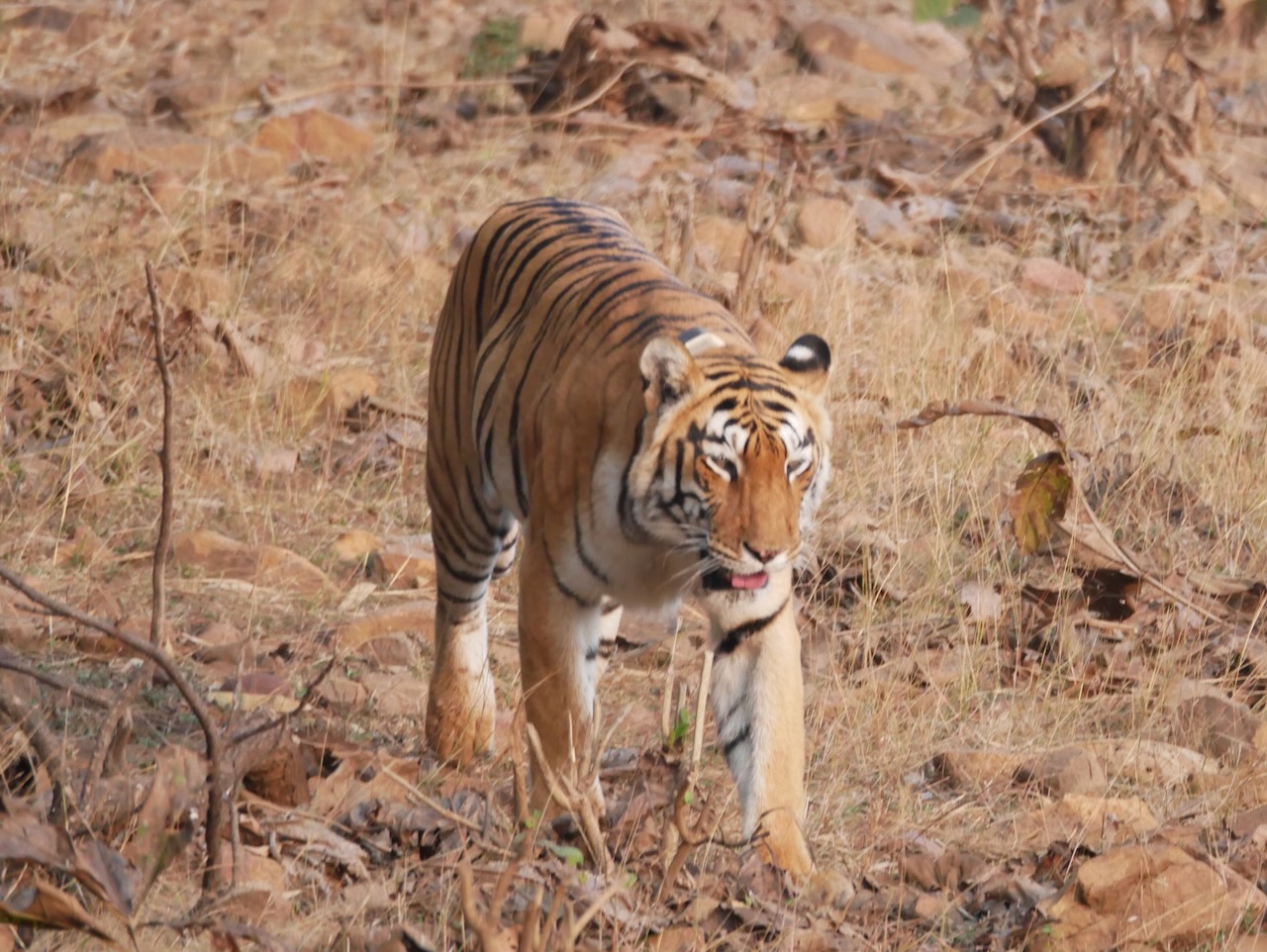
It has been an hour as we drive along the dirt tracks. Everything looks the same and there is no change in the landscape. We are engrossed in our chatter. Ssshh… the gypsy reverses with a sense of urgency, but it seems futile. Then suddenly, out of the tree cover, comes the beauty. Right in front of our eyes, less than a gypsy-length away, we spot our first tiger.
We give out a silent scream of joy (success, victory) as we marvel at the majestic creature. It walks towards us, crosses the road, and disappears into the trees. Not satisfied, neither our eyes nor the camera, we wait. The guide tells us to be patient; he can see the tiger moving through the vegetation. We track its path, visible but shrouded, until it reappears, walking straight towards us. Click, click, click, click… and then the gypsy moves. Why? Because the tiger is now too close, walking right beside us, barely a few feet away. We shift to one side of the bench as she passes, taking her time, putting on a show for the two or three vehicles gathered there. After giving both our eyes and our lenses their fill, she disappears back into the jungle.
That was our first proper tiger sighting in the Indian jungle: Choti Tara, on 22nd February 2020, at 7:37 AM. The quest was finally successful.

This was our third trip to the Indian jungle with one goal: to spot the tiger. It was our eighth safari across three trips, and we had seen everything except the tiger. We had been to Kanha, we had been to Pench, but it was finally at the Tadoba Andhari Tiger Reserve (TATR) that we got there.
TATR is often overlooked by Indian tourists in favour of Madhya Pradesh’s more developed, better-marketed parks (Kanha, Bandhavgarh, Pench), each backed by the likes of Taj Safaris and Pugdundee. But Tadoba’s tiger population is genuinely excellent, giving it the best sighting odds of any park we’ve visited, thanks to a combination of tiger numbers and the size of the reserve, what I’d call the best “tiger saturation” in the country. It may not be the most beautiful jungle (Kanha still holds that title for me), but it packs a real punch when it comes to sightings.
Getting There
TATR is a short drive from Nagpur: 90 to 150 minutes depending on which gate you’re headed to. We took the Nagpur Duronto on the evening of 20th February 2020, arriving into Nagpur early morning on the 21st, having booked First Class tickets for the entire group of twelve, a comfortable overnight journey made easy by planning well in advance. Flying to Nagpur is equally well-connected from Mumbai, Delhi, Kolkata and other major cities.
The closest gate, Kolara, is about 100 minutes away; we were staying close to Khutwanda Gate, a little over 2 hours from the airport (about 15 minutes less if arriving by train). A good stop for breakfast after the overnight journey is the Radisson Blu or Le Meridien; we went with a five-star over local options mainly for clean facilities to freshen up and a buffet with enough variety for half a dozen kids. Roads were fine on the highway, considerably rougher once off it, a reminder that India’s last-mile connectivity to some of its best wildlife destinations still has a way to go.


Safari Permits: What They Actually Cost
Permit rules here, as with Madhya Pradesh’s parks, are booked online and change constantly. One quirk worth knowing: booking 60–120 days in advance costs roughly four times more (₹4,000 vs. a fraction of that closer to the date), and weekend safaris cost double, so a weekend permit booked 120 days out could run ₹8,000 per person. Factor in the gypsy, guide, and camera fees, and three safaris for one vehicle came to around ₹36,000 in total.
We took the calculated risk of waiting until 59 days before our dates (just inside the cheaper window) to book. The only real danger of waiting is that slots can fill up by then, but it worked out for us. We got our permits from Khutwanda Gate as planned, though one of our three safaris required entry from Moharli Gate instead.
Where to Stay
TATR’s popular gates are Moharli, Kolara and Khutwanda. Moharli and Khutwanda sit close together and are easy to move between; Kolara is further out, worth staying near only if all your permits are specifically from that gate. Near Kolara, Svasara Jungle Lodge and Bamboo Forest (known for having the best in-house vehicles) are strong choices.
We chose something different from a typical resort: a homestay called Tigress@Ghosri, near Khutwanda Gate, run by Poonam and Harshwardhan Dhanwatey, a couple of genuine wildlife enthusiasts who also run an NGO in the area. It’s a small bungalow with just four rooms opening onto a large shared living and dining space, overlooking a private pool, built for the feeling of togetherness a big group wants, rather than the more anonymous feel of a resort. Booking was simple, and Poonam was hands-on in helping plan the visit.
Meals were cooked to order and served family-style: simple, tasty home-style Indian food (poha, upma, toast, baked beans, eggs for breakfast), not fancy continental fare, so set expectations accordingly. One thing worth flagging: Chandrapur district, where Tadoba sits, is a dry (alcohol-free) zone, a reason some travellers steer toward other parks instead. Service throughout was warm, though it would have been nice to interact with the owners themselves a little more during the stay. The property’s own watering hole is visited by all kinds of wildlife, including tigers, leopards and bears, right from the grounds.
For single families rather than large groups: Limban Resorts (Khutwanda) or Irai Safari Retreat (Moharli) are both solid alternatives.


Day 1: A Familiar Disappointment
We were, by now, a group of twelve: Raghav, Devpriya, elder daughter Anushka, and younger daughter Advika (born November 2016); Rakhi Garg with son Krishang; Toral Ghelani with son Aarhaan Shah; and Anurag with wife Arushi, daughter Kanushi, and their younger daughter Aavishi. It was our first afternoon/evening safari on the 21st, straight after lunch, and the first-ever safari for both Advika and Aavishi, the newest, youngest members of our jungle gang, both around three years old at the time.

It was a disappointing outing: we were out toward the end of the drive, and neither did we spot a tiger, nor was the jungle otherwise teeming with life. On the way out, we noticed a cluster of vehicles gathering near a waterhole, clearly a sighting in progress. Our driver worked every trick available (reversing, cutting lanes, jostling for position) to get us to the front. Even with the best spot we could manage, the tiger was too far for anything but binoculars or a telephoto lens, and even then, only a partial view.


This was, again, a 3-day, 2-night trip, a night shorter than the 3-nights-minimum we’d generally recommend based on our experience across all three of these trips.
Day 2: The Day It All Came Together
This was the day described at the very start: Choti Tara, up close, at 7:37 AM. After that encounter, we were buzzing for more. Word came of tiger movement near another waterhole; we went, but it was crowded and the tiger stayed hidden in the bushes. We continued on with no luck, then circled back on our way out; by then, some vehicles had left, opening up a good position. Luck held: Matkasur came out to the water, giving us ample time with both eyes and cameras before settling into the bushes.
And just as we were exiting the park, entirely without warning, we came across Tadoba’s famous tigress, Maya, right on the road to the exit. Three close tiger sightings in a single safari, more than making up for six disappointing rides across our two previous trips.


Day 3: One Last Show
Fully satisfied after the previous day, we went out for a final, shorter safari, more for the jungle feel than in expectation of anything more. Our luck held anyway: this time it was Rudra, who walked straight across the track, cutting between a dozen-odd waiting vehicles. Gypsies made way on both sides as he crossed, taking his time, putting on a show before disappearing back into the trees. Everything comes to a standstill when a tiger is around, and the moment it vanishes, the silence breaks into chatter and engines starting up again. We headed back to the lodge hungry, but with hearts thoroughly satisfied.


Three Trips, Eight Safaris, and Finally: The Tiger
Tadoba isn’t the prettiest of the three parks we visited on this quest (Kanha still wins that for me), and honestly, sightings of anything other than the tiger were noticeably thinner here than at either Kanha or Pench; we came away with far fewer of the deer, bird and general wildlife moments that had filled our earlier drives. But for pure tiger odds, nothing else came close. Five tigers across three safaris, after two entire trips that had given us nothing but pug marks and near-misses.
That was the end of this particular chapter for our group: three trips, eight safaris, and a quest finally answered. Having spotted four to five tigers on this trip alone, we started looking beyond tiger reserves for what came next: the Jawai Leopard Safari in Rajasthan and Kaziranga National Park in Assam, for the rhinoceros, both firmly on our agenda going forward.


#TadobaAndhariTigerReserve #TATR #IndianSafari #TigerSafariIndia #IncredibleIndia #MaharashtraTourism #QuestForTheTiger #WildlifeIndia #FamilyTravelIndia #TigerSighting #IndianJungleSafari
Leave a Reply